
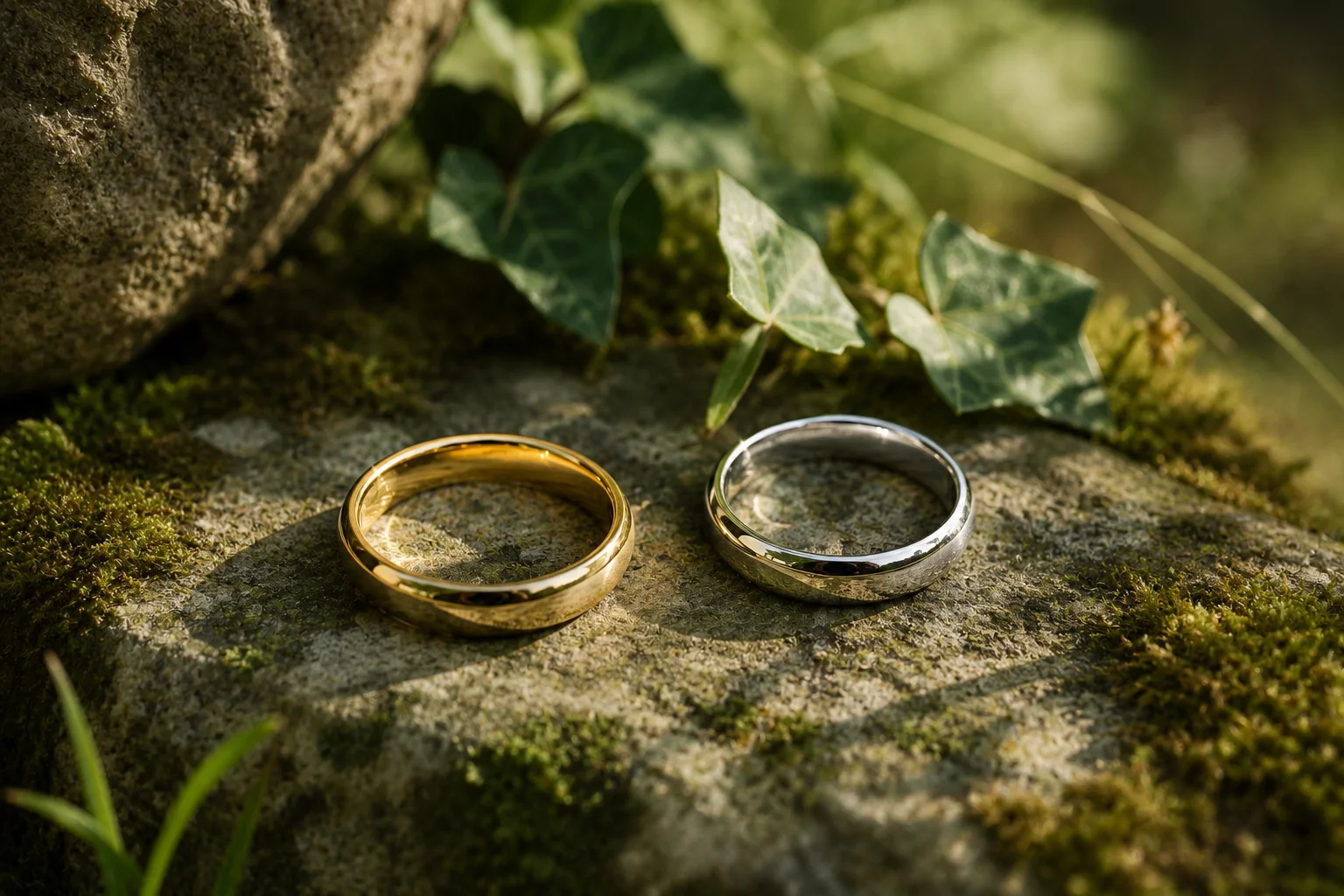
For frequently worn memorial jewelry, 18K gold and platinum are two solid options. 18-karat gold combines a high proportion of gold with the resistance provided by its alloys; Platinum stands out for its density, stability and resistance to deformation. The best choice depends on the design, daily activity, the color sought and the maintenance you accept.
A gem focuses the eye, but the metal decides a large part of the experience of wearing a jewelry. It determines the tone of the piece, setting height, hand feel, ease of maintenance, and how the design ages with use. In a commemorative jewel, this choice deserves the same attention as the diamond or colored stone: the metal is not a neutral background, but the structure that protects and accompanies a memory for years.
The question shouldn't just be “which metal is prettier?” It also matters how you live, whether you will work with your hands, whether you want a piece for every day, whether you prefer a warm or cool finish, whether the jewelry will be a ring, a pendant or a bracelet, and what story you want it to tell over time.
What does it mean for a metal to be noble?
In jewelry, the expression “noble metal” usually refers to precious metals with great value, beauty and resistance to corrosion, such as gold and platinum. It doesn't mean they are indestructible. All metals can be scratched, impacted, or warped if the design is too thin for its intended use. Good jewelry is not about promising that a piece will never change, but about choosing an alloy, thickness, and setting that is consistent with its real life.
Pure, 24-karat gold has exceptional color intensity, but is too soft for many everyday wear pieces. That is why it is alloyed with other metals. The World Gold Council explains that 18-karat gold contains 75% pure gold and 25% other metals, usually combinations that can include silver, copper, palladium or zinc. This mixture allows the color, hardness and behavior of the metal to be adjusted.
The platinum used in fine jewelry usually has a very high purity. It is a naturally white metal with great density. It does not need rhodium plating to be white, although it can acquire a soft, satiny patina over time. Some people love it because it tells the story of use; Others prefer to polish it from time to time to recover a more specular shine.
18-karat gold: balance between wealth and everyday use
18K gold is a popular choice for jewelry intended to accompany a complete life. It has a warm presence, good workability for the jeweler and a high proportion of precious metal. Compared to 24-karat gold, the alloy improves its mechanical behavior; Compared to lower carats, it retains a notable gold content and a richer tone.
18K yellow gold is usually the most classic option. It works especially well when you are looking for a timeless design, when the person is wearing accessories in warm tones or when you want to create contrast with a colorless diamond. It can also visually reinforce the color of yellow stones, champagne or honey. Its beauty doesn't depend on a specific trend: a clean yellow gold hoop can feel contemporary today and still look elegant decades from now.
18K white gold offers a colder and more discreet aesthetic. It is a good option when you want the setting to visually blend with a white diamond and leave all the prominence to the gem. Many white gold alloys are finished with rhodium plating to achieve a deep white. With use, that bathroom can gradually wear out and require renovation. It is not a defect: it is a maintenance feature that should be known before choosing.
18K rose gold gets its color thanks to a greater presence of copper in the alloy. It has a soft, intimate and luminous nuance, especially attractive in small-scale pieces. It can be a great choice for those looking for a less conventional metal without giving up sobriety. As with any alloy, the specific formulation may vary between workshops; If you have a known sensitivity to certain metals, ask about the ingredients.
Platinum: stability, weight and a patina that tells the time
Platinum has a different presence. It is denser than gold, so a comparable piece often feels heavier and more solid. Its natural white color does not depend on a superficial bath. Furthermore, its behavior against wear is particular: when it is rubbed, the metal tends to move more than to lose volume, which favors its use in settings that must preserve the safety of a gem for a long time.
Organizations specializing in platinum highlight its resistance to wear, bending and long-term deformation. That doesn't automatically make platinum the best alternative for every design. Its greater density implies a different material cost and may not be necessary in a light pendant that hardly takes any knocks. But in a ring that will be worn every day, in delicate prongs or in a bezel that must embrace a diamond, it is a very technically relevant option.
The so-called patina of platinum deserves an honest explanation. With use, the surface may develop micro-scratches that slightly blur the mirror reflection. The jewel is not “damaging”: it is acquiring a surface texture. It can be kept like this, with a more matte and vivid beauty, or reviewed by a professional to restore shine. Choosing platinum also means deciding if you like a piece of jewelry that shows the passage of time or if you prefer a more polished finish.
Metal and gem safety
The metal not only frames the stone: it directly participates in its protection. A diamond is extremely hard to scratch, but can chip with a strong impact in vulnerable areas, such as the points of a heart, pear, or marquise. The geometry of the setting and the quality of workmanship matter as much as the material.
The claws allow a lot of light to enter the gem and give an open appearance. A six-claw design can offer additional redundancy over four; If one claw suffers damage, the whole has more support. The full bezel surrounds the edge of the stone with metal, protecting the ring and reducing the risk of snagging. A half bezel leaves more facets visible, but requires careful planning. For active lifestyles, a low-profile ring with a bezel or sturdy prongs may be more practical than a tall solitaire.
Platinum is highly prized for claws for its ability to hold its own, while 18K gold offers excellent versatility for building bodies, sides and volumes. Metals are often combined within the same piece: for example, a yellow gold hoop with a platinum head for a white gem. It is not a mandatory rule, but a possible technical and aesthetic solution.
How to choose according to the type of jewelry
For an everyday ring
Think first about friction, impacts, water, cleaning products, gym, gloves and manual labor. 18K gold and platinum are suitable options if the thickness of the ring and setting are well designed. Choose a reasonable height and avoid very thin structures if you know you won't be removing the piece for intense activities.
For a pendant close to the heart
A pendant usually suffers fewer direct blows than a ring. Here the tone of the metal and comfort can outweigh maximum robustness. Yellow, rose, white, or platinum gold work well; The length of the chain, the type of clasp and the orientation of the gem will have a greater daily impact than it seems.
For a bracelet or equestrian jewelry
Bracelets can rub against surfaces, clasps and buckles. Special attention should be paid to the security of the closure, the thickness of the links and the profile of the stone. In designs inspired by the equestrian world, yellow gold can provide classic warmth; platinum and white gold can build a more sober, technical or contemporary language.
Maintenance: the less romantic part that protects the memory
Remove it for tasks that involve abrasive products, chlorine, repeated blows or direct force on the rim. Store it separate from other pieces to minimize friction, especially if it has diamonds that can scratch softer metals and stones.
Clean it periodically with warm water, mild soap and a very soft bristle brush, unless the jeweler indicates otherwise due to the presence of delicate gems or special details. Check prongs, bezels, clasps and solders professionally at least when you notice movement of the gem, unexpected snags or deformation of the ring. Preventative maintenance is a form of care, not a sign that the jewelry is fragile.
Sakti Atelier makes this choice based on the real use of the piece, not from a catalog of automatic responses. The ideal metal is one that allows the design to maintain its intention: to protect the gem, accompany the skin with comfort and remain recognizable for many years to come.
Related Frequently Asked Questions
Not always. 18K gold contains more pure gold and tends to have a richer color; 14 karat can offer greater hardness in some alloys. For fine commemorative jewelry, 18k is a very common choice for its balance between nobility, beauty and wearability.
It can develop micro-scratches, but its wear mode is different and usually preserves the mass of the metal very well. Its qualities are especially useful for long-lasting structures and settings.
White gold is an alloy. Many pieces are rhodium plated for a brighter white; With use, that bathroom may need renovation.
Protection depends on both the design and the metal. A well-made bezel can greatly protect the edge of a gem; A properly executed platinum or 18k gold setting can be excellent.
Yes. It is a common option when looking to combine tone, resistance and design architecture. It should be resolved by a professional who takes construction and maintenance into account.
Choose with use in mind
Gold and platinum offer different and valuable languages. Decide with precise information about alloy, setting, thickness and maintenance, thinking about how you want the piece to age with you.
Sources consulted
- World Gold Council,Gold Jewellery: Colour, Carat & Purity: composition and carat of gold.
- World Gold Council,24 Facts About Gold: 18k gold and alloys.
- Platinum Guild Circle,Durability: behavior of platinum in frequently used jewelry.
- GIA,How to protect your diamond engagement ring: protection of the gem through claws, bezel and design.
- GIA,Gemstone Durability: Design to Display: relationship between durability, design and assembly.
- Reference:World Gold Council.
- Atelier Process: See Sakti Process
- Main Category: Sakti Guide
Suggested Articles:
Create a memory that will last a lifetime
Discover the personalized design and assembly process in our atelier.
Let's talk to the Atelier